essay
On the Shape of Silence
A meditation on empty space in architectural thought
This essay examines how architects and theorists have understood silence not as absence but as a positive force shaping spatial experience.

The Sound of Empty Rooms
Architecture begins not with form, but with the void it contains. The first room was not built—it was carved. And the space that remained, the emptiness that made the carving habitable, was already a kind of silence. Before walls defined territory, before roofs sheltered from rain, there was already the absence that architecture would learn to shape.
This essay is not about acoustics. It is about a deeper silence—the silence of contemplation, of waiting, of the pause between thoughts that a well-designed space can hold open. Architects have always known this silence, even when they lacked the vocabulary to name it.
I. The Void as Material
Louis Kahn, the great American architect, once asked a brick what it wanted to be. The brick answered: "I like an arch." But Kahn's deeper question was always about the space between materials—the joints, the gaps, the distances that give form its meaning. In Kahn's work, silence was not a lack of sound but a presence of potential.
Contemporary architects have inherited this intuition but often lack the conceptual framework to deploy it deliberately. In the rush toward parametric design and computational optimization, the simple power of a quiet volume has been sidelined. Yet the most memorable spaces—the Pantheon's oculus, the moss garden of Saihō-ji, Zumthor's thermal baths at Vals—are all, in their own ways, architectures of silence.
II. The Japanese Garden and Temporal Emptiness
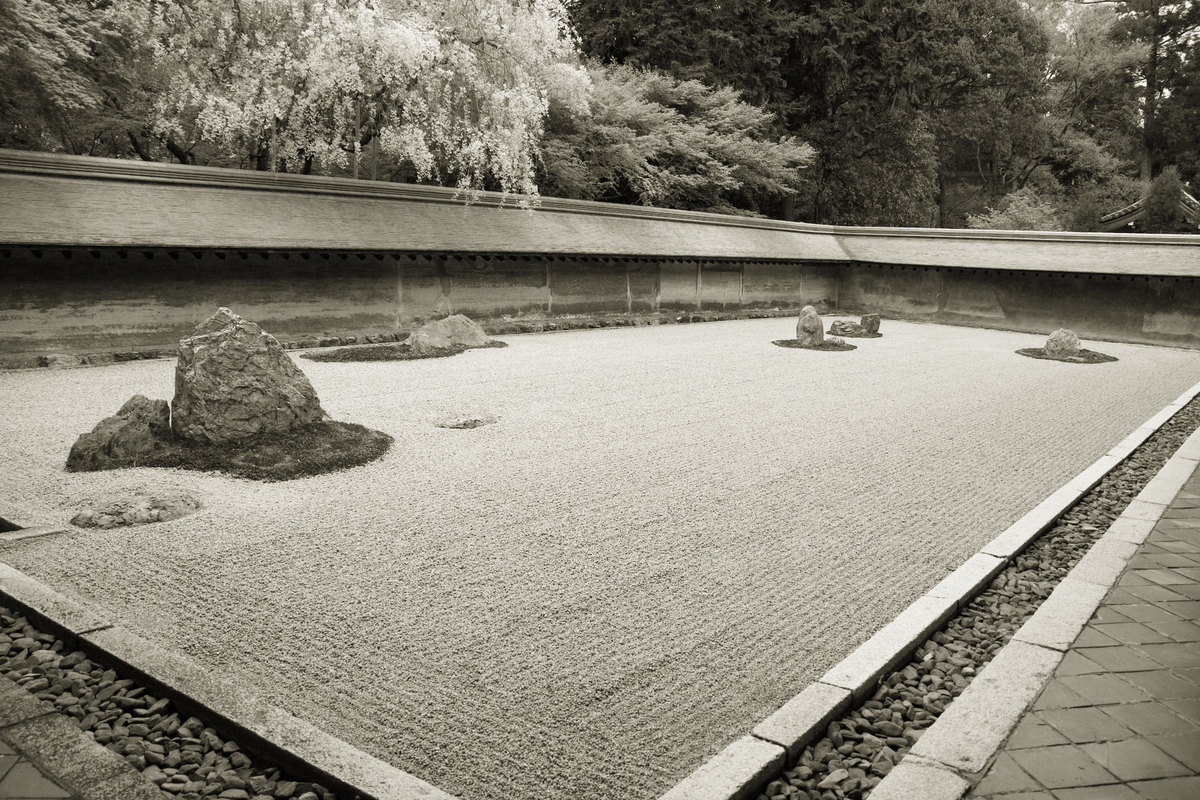
The Japanese dry garden (karesansui) offers perhaps the most explicit model of architectural silence. At Ryōan-ji in Kyoto, fifteen stones sit on raked white gravel. From no vantage point can all fifteen be seen simultaneously. The composition is deliberately incomplete, and it is precisely this incompleteness—this visual silence—that compels us to complete it with our attention.
The garden teaches us that silence, in architecture, is not about emptiness alone. It is about the right kind of emptiness—the emptiness that invites rather than excludes, that holds attention rather than dissipating it. This is the difference between a vacant lot and a courtyard: the former is merely empty, while the latter is a silence that has been shaped.
III. Silence as Resistance
In the twenty-first century, silence has become a political act. Our cities hum with notifications, our buildings broadcast commercial messages, our public spaces are saturated with engineered soundscapes designed to manage behaviour. Against this, architectures of silence offer something radical: a refusal to demand attention, an invitation to simply be present.
Peter Zumthor's Bruder Klaus Field Chapel, completed in 2007 in the German countryside, exemplifies this resistance. The chapel was constructed around a teepee of 112 tree trunks, which were then burned out over three weeks, leaving a charred, cave-like interior. The resulting space is dark, textured, and almost completely silent—not because it suppresses sound, but because it transforms sound into contemplation.
IV. Conclusion: Learning to Listen
What would it mean to design a building as if silence mattered? To begin a project not with a program or a site analysis, but with a question about the quality of quiet the building should hold? This is not mysticism. It is a recognition that architecture—like music—is structured by what it does not say as much as by what it does.
The silence of a great building is not an accident. It is not the residue left over after program and structure have been accounted for. It is the first thing present—the void around which the building is composed—and every architectural decision is, whether the architect knows it or not, a decision about what kind of silence the building will hold.
A room is not a room without natural light. But neither is it a room without shadow—the shadow that silence casts across our attention.
— Louis Kahn, Conversations with Students, 1969
Notes
1 Kahn, Louis. "The Room, the Street, and Human Agreement." AIA Journal, 1971.
2 For a deeper treatment of karesansui and attention, see Nitschke, Günter. "Ma: The Japanese Sense of Place." Architectural Design, 1966.
Bibliography
Credits
- Elena Vasquez — author
- Cquest — photographer